
Child Support in California | Chico Guide to Orders and Changes
In California, child support is calculated using a complex algebraic formula known as the Statewide Uniform Guideline. While it may feel like a simple math problem, the inputs ranging from hidden income to specific parenting time, are often highly contested. California has updated the formula’s income thresholds to better reflect modern economic realities.

How is Child Support Calculated in California?
The core answer is that California follows an “Income Shares” model. The law assumes that a child should receive the same proportion of parental income they would have received if the parents had remained together. To ensure fairness across all 58 counties, California courts use a specific math formula.
CS = K [HN – (H%)(TN)]
The Formula Variables Explained:
- CS (Child Support): The final monthly support amount.
- K (K-Factor): The percentage of both parents’ combined income allocated to the children. This factor varies based on the total income and number of children.
- HN (High Earner’s Net): The monthly net disposable income of the parent who earns more.
- H% (High Earner’s Timeshare): The percentage of time the higher-earning parent has primary physical responsibility for the children.
- TN (Total Net): The combined monthly net disposable income of both parents.
The "Guideline" is the Starting Point
By law, the amount calculated by this formula is “presumptively correct”. This means a judge in Butte County must order the guideline amount unless there is a compelling reason to deviate from it.
Why the “Math” Often Turns into a Legal Battle:
While the formula is rigid, the numbers you “plug in” are not. Most child support disputes in Chico center on three things:
- Defining “Net Disposable Income”: Calculating what is left after mandatory deductions like taxes, health insurance premiums, and union dues.
- Parenting Time Documentation: A parent with 40% timeshare will pay significantly more support than a parent with 49%, even if their incomes are identical.
- Variable Income: Determining how to handle non-guaranteed income like annual bonuses, stock options, or self-employment commissions.

The "Best Interests" Connection
Under California Family Code § 4053, the court’s top priority is the child’s interests. Support is not a punishment for the paying parent or a windfall for the receiving parent; it is a legal mechanism to ensure children enjoy a consistent standard of living in both households.
Is the standard formula working against you?
Whether you believe the current calculation is based on inaccurate income or an unfair timeshare percentage, you don’t have to accept the first number that pops out of a calculator. Our Chico team helps parents ensure that every variable from tax deductions to actual hours spent with the child—is documented and defended in court.
Talk to a Support Specialist about your calculation today
Past results do not guarantee future outcomes. Alternative service requires specific court orders and strict adherence to the California Code of Civil Procedure.
The Inputs (Income, Deductions, and Timeshare)
In California, child support isn’t just about your base salary. To reach the “Guideline” amount, the court must determine your Net Disposable Income. This involves a deep dive into every dollar coming in and several specific dollars going out. In Butte County, accuracy at this stage is vital because once a number is plugged into the court’s software (like DissoMaster), the resulting order becomes legally binding.
1. Defining "Income"
Under California Family Code § 4058, income is defined broadly. It includes more than just a W-2 paycheck. The court looks at: The court looks at income for support purposes.
- Wages and Commissions: Base salary plus any overtime or performance bonuses.
- Self-Employment Income: Gross receipts minus the expenses necessary to run the business.
- Passive Income: Rental income, dividends, interest, and trust distributions.
- Employee “Perks”: If your employer pays for your car, gas, or housing, the court may “add back” that value to your income.
- Public Benefits: While some benefits (like SSI) are excluded, others (like Social Security Disability or Unemployment) are counted as income for support purposes.
2. Mandatory vs. Discretionary Deductions
To move from “Gross” to “Net,” the court subtracts specific items. Not every bill you pay counts as a deduction.
- Mandatory Deductions: Federal and state income taxes, FICA (Social Security/Medicare), mandatory union dues, and mandatory retirement contributions.
- Health Insurance: The actual cost of health insurance premiums for the parent and any children from other relationships is deducted.
- Hardship Deductions: In limited cases, a judge may grant a “hardship” deduction for extraordinary medical expenses or for the basic living expenses of children from other biological relationships who live with you.
3. The "Timeshare" Variable: The Biggest Swing Factor
The most frequent point of contention in Chico custody cases is the Timeshare Percentage (H%). This is the approximate percentage of time the high-earner has primary physical responsibility for the children.The most frequent point of contention in Chico custody cases is the Timeshare Percentage (H%).
- How it works: As your parenting time increases, your child support obligation generally decreases because the law assumes you are spending more on the child’s direct needs (food, utilities, entertainment) while they are in your care.
- The “Cliff” Effect: Even a small change (e.g., moving from 20% to 35% time) can result in hundreds of dollars of difference in monthly support.
4. Mandatory "Add-Ons"
Beyond the base monthly payment, California law requires parents to share certain costs, usually 50/50:
- Childcare: Costs related to employment or necessary education/training for job skills.
- Uninsured Healthcare: Co-pays, dental work, vision, and prescriptions not covered by insurance.
- Educational/Special Needs: Costs for schooling or special needs related to a disability.

Strategic Insight: The "Bonus" Problem
If your income fluctuates due to seasonal work or annual bonuses, we often advocate for a Smith-Ostler Order. Instead of setting a high monthly support amount based on a one-time bonus, the court sets a lower base amount and requires you to pay a specific percentage of any “extra” income only when you actually receive it. This protects you from being “over-ordered” during slow months.
Modification & "Change in Circumstances"
In California, a child support order is rarely “set in stone.” Because lives and finances are constantly in flux, the law allows for modifications to existing orders. However, you cannot change a support amount simply because you are unhappy with the original number. You must prove that there has been a “significant change in circumstances” since the last order was signed. Because lives and finances are constantly in flux, the law allows for modifications to existing orders.
The Legal Standard for Modification
To successfully request a change in support in the Butte County Superior Court, you must demonstrate a material shift in the variables used in the original calculation.
Common “Significant Changes” Include:
- Income Fluctuations: A significant raise, a promotion, a job loss, or a transition to disability/retirement.
- Changes in Parenting Time: If the “Timeshare” percentage has shifted—for example, a child is now spending significantly more nights at one parent’s house than previously ordered.
- Changes in Child’s Needs: New expenses for healthcare, special education, or the end of a childcare requirement (e.g., the child starts full-day school).
- The “Six-Month Rule” for Income: Generally, the court looks for changes that are expected to be long-term rather than a one-week dip in hours.
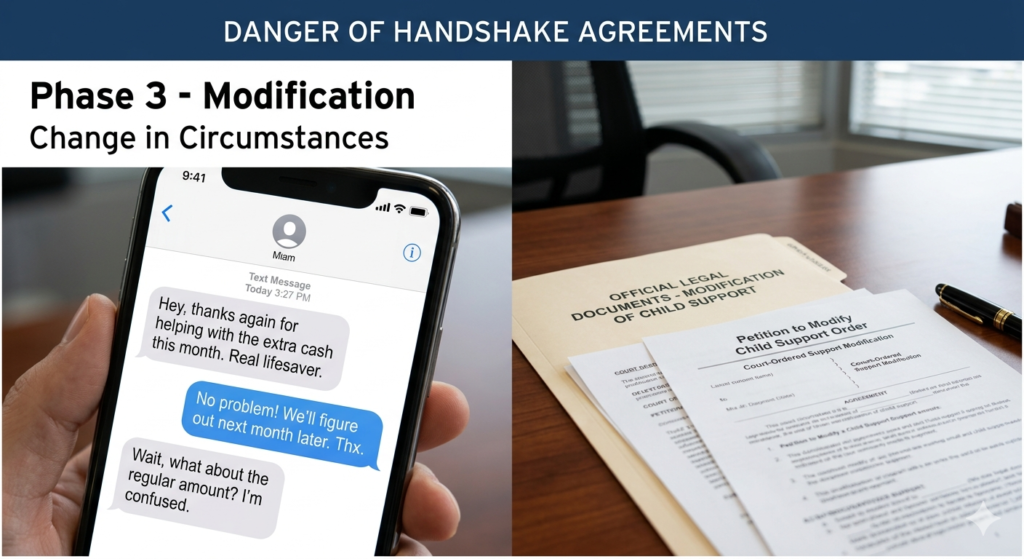
The Dangers of the "Handshake Agreement"
One of the most common mistakes parents in Chico make is agreeing to a “verbal change” in support.
- The Scenario: One parent loses their job, and the other parent agrees to accept $200 less per month until they find work.
- The Reality: Under California law, a verbal agreement does not change the court order.
- The Consequence: The $200 per month “discount” continues to accrue as arrears (debt). Years later, the receiving parent can demand that unpaid money, plus 10% statutory interest, and the court must enforce it because the original order was never formally modified.
The "Retroactive" Rule (Why Timing is Everything)
In California, a judge generally cannot change your child support amount backward to the date your income dropped. They can only modify support retroactively to the date you filed your formal request (the “Notice of Motion” or “Request for Order”) with the court.
- If you lose your job today: You must file the modification paperwork immediately. If you wait three months to file, you are legally responsible for the higher payment for those three months, even if you had zero income.
How the Modification Process Works
- File the Request for Order (RFO): Submit form FL-300 to the court explaining the change in circumstances.
- Serve the Other Parent: Ensure they are legally notified of the request.
- Financial Disclosure: Both parents must provide updated Income and Expense Declarations.
- The Hearing or Stipulation: If both parents agree to the new amount, they can sign a stipulation for a judge to sign. If they disagree, a judge will decide the new amount after a hearing.
Has your financial situation shifted? In child support law, “waiting and seeing” is a strategy that often leads to massive debt or missed support. Whether your income has dropped or you’ve noticed the other parent’s lifestyle has significantly improved, the time to act is the moment the change occurs.
[Schedule a Modification Review to protect your financial rights.]
Past results do not guarantee future outcomes. Alternative service requires specific court orders and strict adherence to the California Code of Civil Procedure.
Enforcement, Arrears, and the DCSS
When a parent fails to pay court-ordered child support, the debt doesn’t just disappear—it becomes Arrears. In California, child support debt is one of the most strictly enforced types of financial obligations. It cannot be discharged in bankruptcy, and it carries a mandatory interest rate that can quickly double the original balance.
At the Rooney Law Firm, we represent both parents seeking to collect unpaid support and those who need help navigating the aggressive enforcement tactics of the state. We represent both parents seeking to collect unpaid support…

The Enforcement Powerhouse: DCSS
The Department of Child Support Services (DCSS) is the government agency responsible for establishing and enforcing support orders. In our region, this is managed by the Butte County DCSS (located in Oroville and Chico).
While you do not need to be a “customer” of DCSS to have a child support order, once they are involved, they have a massive “toolkit” of enforcement powers that do not require a new court hearing to activate.
Methods of Enforcement & Their Consequences
The state has several ways to ensure compliance. If you are the receiving parent, these are your avenues for collection. If you are the paying parent, these are the risks of non-compliance.
Complex Scenarios (High Earners & Hidden Income)
While the California Guideline formula is the standard, it isn’t always a perfect fit. In cases involving high-income earners or self-employed individuals, the “math” becomes secondary to the investigation. In Chico and throughout Butte County, these complex cases require a “deep dive” into financial structures to ensure the support order truly reflects the parents’ standard of living.
1. High-Income Earners: The "Lifestyle" Exception
In California, there is a legal concept known as the “Extraordinarily High Earner” exception (Family Code § 4057). If a parent’s income is so high that the standard formula would result in an amount far exceeding the child’s actual needs, the court can deviate from the guideline.
- The “Wealthy Child” Standard: The court doesn’t just look at basic needs (food/rent); it looks at the lifestyle the child would have enjoyed if the parents were together. This includes private schools, club sports, international travel, and luxury housing.
- The Burden of Proof: The high-earning parent must prove that the guideline amount is “unjust or inappropriate” because it exceeds what is necessary to maintain that high standard of living.
2. The Battle of "Hidden" or Underreported Income
Self-employed parents or business owners in Butte County often have “flexible” income. If a parent is “doctoring the books” to show low personal income while the business pays for their lifestyle, we use Discovery to uncover the truth.
- Forensic Accounting: We look for personal expenses (meals, travel, car payments, home utilities) being run through a business.
- Imputing Income: If a parent is intentionally unemployed or “underemployed” (e.g., a licensed surgeon working at a coffee shop to avoid support), the court can impute income. This means the judge calculates support based on what that parent could be earning, rather than what they claim to be earning.
3. Multiple Children & "Serial" Support Orders
Navigating support is significantly more complex when a parent has children with multiple partners.
- The “First in Time” Myth: Contrary to popular belief, the “first” child doesn’t always get the most.
- The Formula Adjustment: California uses a “Hardship Deduction” or a specific formulaic adjustment for “prior children” to ensure that the parent can realistically support all of their children without falling below the poverty line.
- Overlapping Orders: We ensure the court’s software accounts for every existing support order to prevent “stacking” that leads to 80% of a paycheck being garnished.
Strategic Insight: The "New Spouse Income" Trap
A common question in Chico is: “Does my ex’s new spouse have to pay for my child?”
- The Rule: In California, the income of a new spouse or domestic partner is generally not counted toward child support.
- The Exception: The only time a new spouse’s income matters is when it puts the parent in a lower tax bracket (giving them more “net disposable income”) or in extreme cases of “extraordinary hardship” where a child would otherwise suffer.
Preparation Checklist: What to Gather Before Your Hearing
Don’t walk into court empty-handed. To ensure the calculation is accurate, gather the following:
- Income Verification: Your last two months of pay stubs.
- Tax Returns: Copies of state and federal returns from the last two years (including W-2s and 1099s).
- Healthcare Costs: Documentation of the monthly premium you pay specifically for the children’s health insurance.
- Childcare Receipts: Proof of payment for work-related daycare or after-school programs.
- Mandatory Expenses: Evidence of union dues or mandatory retirement contributions.
- Timeshare Logs: If parenting time is disputed, bring a calendar showing the actual nights spent with the child over the last 12 months.
Frequently Asked Questions
It is based on a statewide formula that primarily looks at both parents’ monthly net incomes and the percentage of time each parent spends with the child.
Yes, provided there is a “significant change in circumstances,” such as a new job, job loss, or a shift in the custody schedule.
A lawyer can use subpoenas to obtain bank statements, lifestyle evidence, and business records to ask the court to “impute” income based on their true earning capacity.
The debt accrues 10% interest annually. The state can garnish wages, suspend licenses, and intercept tax refunds to satisfy the debt.
Yes. Failure to provide current financial documentation can result in the judge continuing (delaying) your case or making an order based on “estimated” income that may be unfair to you.
Take Control of Your Child’s Financial Future
Child support is more than just a monthly transaction; it is a vital resource for your child’s stability. Whether you are being asked to pay an amount that feels impossible or you are struggling to get the support your child deserves, the Rooney Law Firm is here to ensure the “math” is fair.
The laws are stricter and the digital tracking is faster. Don’t leave your financial health or your child’s well-being to chance or an online calculator.
[Request Your Child Support Strategy Session]
Chico Phone:
(530) LAW-HELP (530-345-5678)
Toll Free:
(800) TKO-4LAW (800-856-4529)
24/7 Secure Text Line:
(530) 529-4357

Table of Contents
Need Help With Child Support?
You do not have to rely on guesswork or an online calculator. Child support in California depends on income, deductions, parenting time, add-on costs, and changes in circumstances. Early legal guidance can help you understand the numbers, protect your financial rights, modify unfair orders, and address unpaid support in Chico and Butte County.
What Is a CVSA Test and How Can It Help Clear Your Name in Chico? We Use the Same Tools Law Enforcement Uses. And We Use Them For You. Rooney
Truck Accidents in Chico, California: What Victims Should Know Truck accidents in Chico can leave families dealing with serious injuries, lost income, and difficult questions about what to do next.
Top 5 Dangerous Intersections in Chico CA for Car Accidents Dangerous intersections in Chico CA can put drivers at serious risk because of traffic volume, turning conflicts, poor visibility, and