
Truck Accidents in Chico, California: What Victims Should Know Truck accidents in Chico can leave families dealing with serious injuries, lost income, and difficult questions about what to do next.

Property crimes in California are a broad category of offenses involving the illegal taking, damaging, or destruction of someone else’s property. While these charges are often described as “non-violent,” the California Penal Code treats many property crime offenses, particularly residential burglary, with extreme severity, carrying the potential for years in state prison and permanent “strikes” on a criminal record.

The core answer is that property crimes focus on the victim’s assets rather than their physical person. Under the California Penal Code, the most common charges include:
Unlike some traffic offenses where your “intent” doesn’t matter, almost every California property crime is a specific intent crime. This means the prosecution must prove not just that you took or damaged something, but that you intended to do so unlawfully at the exact moment the act occurred.
In Chico and Butte County, many people mistakenly believe that “petty” property crimes aren’t a big deal because of Proposition 47, which reclassified many thefts under $950 as misdemeanors.
However, even a misdemeanor conviction for shoplifting or vandalism can:
Are you being investigated for a property crime?
In California, the line between a misdemeanor and a felony often comes down to how the police report describes your “intent” and the “valuation” of the property. Early intervention by a defense attorney allows us to challenge these descriptions before the District Attorney even files formal charges.
[Speak with a Chico Defense Strategist about your case] Early intervention by a defense attorney allows us to challenge these descriptions before the District Attorney even files formal charges.
Past results do not guarantee future outcomes. Alternative service requires specific court orders and strict adherence to the California Code of Civil Procedure.
In California, people often use the terms “theft,” “burglary,” and “robbery” interchangeably in conversation, but in a courtroom, they are distinct offenses with vastly different penalties. Understanding the “elements” of each charge is the first step in building a defense.
Theft is the most straightforward property crime. It occurs when you take someone else’s property with the intent to permanently deprive them of it. There is no requirement for a “break-in” or a confrontation with a victim.
Burglary is often misunderstood; you do not actually have to steal anything to be charged with it. The crime is “complete” the moment you enter a room, building, or locked vehicle with the intent to commit a theft or any felony inside.
Robbery is frequently confused with theft, but it is actually classified as a violent crime. It involves taking property from a person’s immediate presence, against their will, using force or fear. Because of the element of confrontation, it is always a felony and a serious “strike”.
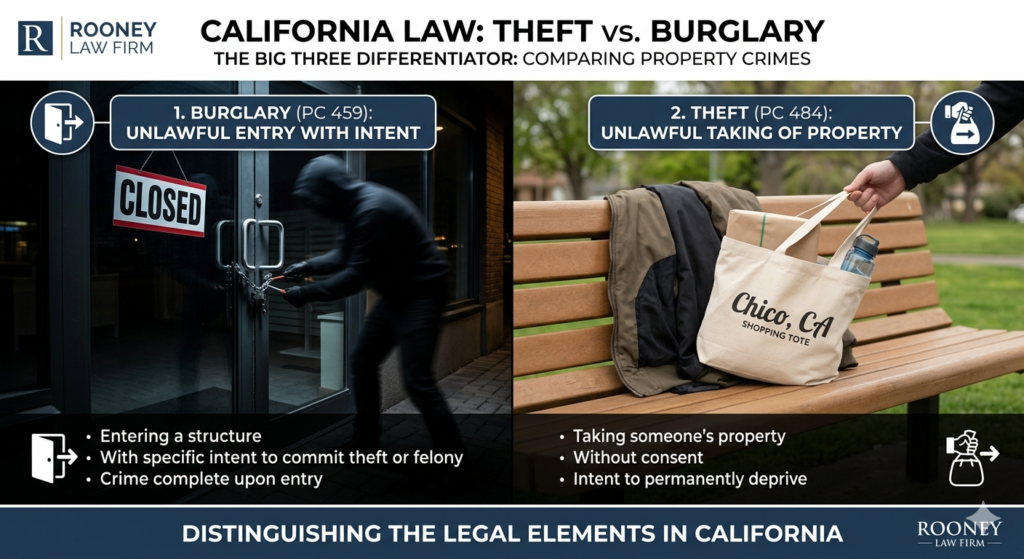
The following table breaks down the critical differences between these commonly charged offenses.
Charge | Key Legal Element | Typical Prosecution Requirement | Potential Penalties |
Petty Theft (PC 484) | Taking property < $950 | Must prove intent to steal permanently. | Up to 6 months jail; $1,000 fine. |
Grand Theft (PC 487) | Taking property > $950 | Proof of value and intent. | Up to 3 years in jail (if felony). |
Commercial Burglary | Entry into a business | Must prove intent at the time of entry. | Up to 3 years in jail (if felony). |
Residential Burglary | Entry into a home | Always a felony; “Strike” offense. | 2, 4, or 6 years in state prison. |
Robbery (PC 211) | Force or Fear | Theft directly from a person. | 2 to 9 years in state prison; “Strike”. |
In Butte County, it is common for a single incident to trigger “stacked” charges. For example, if someone enters a store with the intent to shoplift a $1,000 item, they could be charged with both Commercial Burglary (for the entry) and Grand Theft (for the value of the item). A strong defense strategy often involves attacking the “intent” element to reduce these stacked charges into a single, lesser offense.
In California, the severity of a property crime often hinges on two critical factors: the market value of the property and the specific intent of the individual. Understanding these mechanics is vital, as they represent the primary areas where a defense can successfully challenge the prosecution’s case.
Under Proposition 47 and Penal Code § 487, the value of $950 is the “legal line” that determines your exposure.
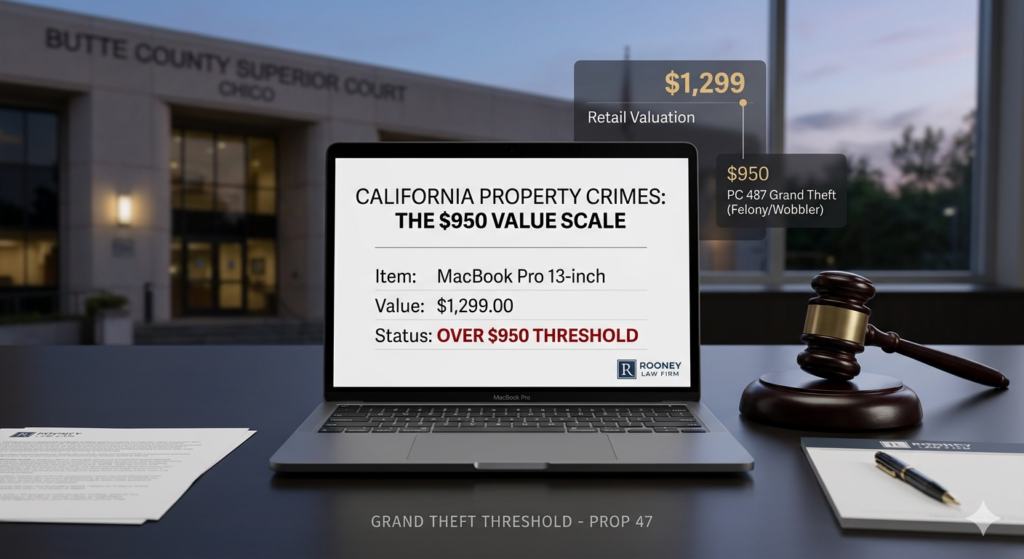
Value is not determined by what you think the item is worth or its original retail price. California law uses Fair Market Value, the highest price the item would reasonably have sold for in the open market at the time and place it was taken.
Property crimes like burglary and theft are specific intent crimes. This means the prosecution must prove beyond a reasonable doubt that you had a particular mental state at the time of the act.
California has a specific statute for retail theft known as PC 459.5 Shoplifting. This law applies if you enter an open business during regular hours with the intent to steal property worth $950 or less. By law, if your actions meet the definition of shoplifting, you cannot also be charged with burglary for the same act.
While many property crimes focus on “taking,” California law also strictly penalizes the destruction or defacement of property. These charges, vandalism and arson, carry significant weight in Butte County, especially when the damage occurs to residential property or public spaces.
Vandalism is the act of maliciously defacing with graffiti, damaging, or destroying property that is not your own. In California, the “price tag” of the damage determines whether the case is a misdemeanor or a felony.
Arson is among the most serious property crimes because it inherently risks human life. California differentiates between “willful” arson and “reckless” burning.
Often viewed as a “nuisance” crime, trespassing involves entering or remaining on someone else’s property without permission. While usually a misdemeanor, it can be elevated to “Aggravated Trespassing” (PC 601) if you make a credible threat to harm someone and then enter their home or workplace without permission.
In Chico, we frequently see vandalism charges arise during domestic disputes, for example, breaking a spouse’s phone or kicking in a door during an argument. Even if the property is “community property” (shared by the couple), you can still be charged with vandalism for damaging it. Because these cases often overlap with Domestic Violence allegations, the legal stakes are doubled, requiring a defense that addresses both the property damage and the relationship dynamics.
Is a “misunderstanding” being called vandalism?
Damage isn’t always “malicious.” Sometimes accidents happen, or property is damaged during a mental health crisis. We work to reposition these cases as civil matters or negotiate for restitution (paying for the damage) in exchange for a dismissal or reduction of criminal charges.
[Learn how we defend against vandalism and arson charges.] We work to reposition these cases as civil matters or negotiate for restitution in exchange for a dismissal or reduction of criminal charges.
A property crime charge is not a conviction. In California, several powerful legal defenses can lead to a dismissal or a reduction of charges. The focus of our defense at the Rooney Law Firm is to expose the gaps in the prosecution’s evidence regarding your “specific intent.”
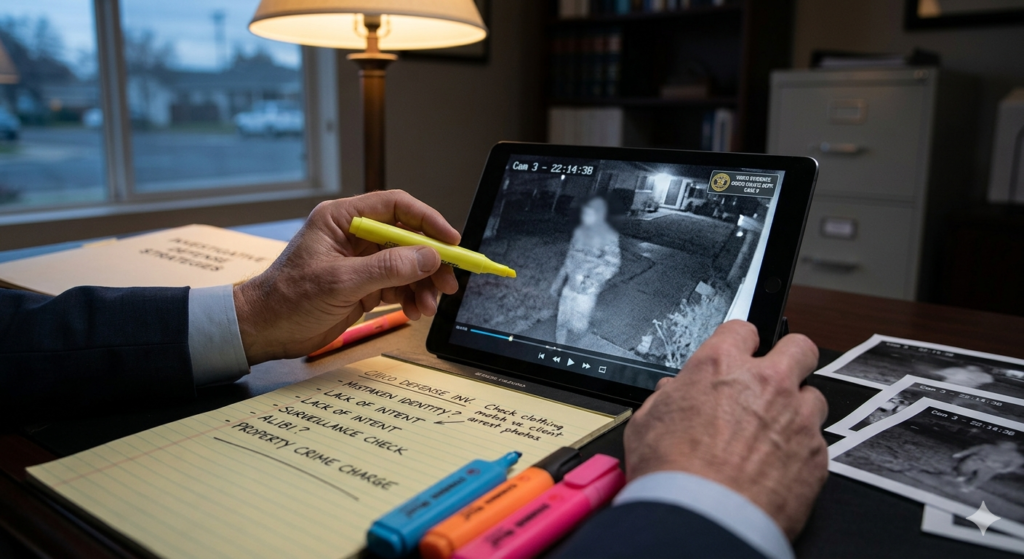
In certain misdemeanor cases (like shoplifting or minor vandalism), we can pursue a Civil Compromise. If the victim (the store or property owner) acknowledges they have been fully compensated for their loss and no longer wish to prosecute, the judge has the power to dismiss the criminal case entirely.
Is your side of the story being ignored?
The police only provide the prosecution with evidence that supports a guilty verdict. Our job is to present the “Claim of Right” or “Lack of Intent” evidence that the police missed.
[See how a strategic defense can change your case outcome. See how a strategic defense can change your case outcome.
Past results do not guarantee future outcomes. Alternative service requires specific court orders and strict adherence to the California Code of Civil Procedure.

Any crime involving the theft, damage, or unauthorized entry of property. Common examples are shoplifting, burglary, and vandalism.
Theft is the act of taking property. Burglary is the act of entering a building or locked car with the intent to steal, even if nothing is actually taken.
Yes. Through “Civil Compromise,” lack of intent defenses, or successful completion of a diversion program, many first-time offenses can be cleared from your record.
No. Anything you say “to clear things up” can be used as a confession of intent. Politely decline to answer questions and contact an attorney immediately.
A property crime charge can feel like a heavy label, but it doesn’t have to stay that way. The Rooney Law Firm has spent over 30 years protecting the residents of Chico and Butte County from the life-altering consequences of a criminal record. We don’t just “process” cases; we hunt for the technicalities and lack of evidence that the prosecution hopes you won’t notice.
Protect your record. Protect your reputation. Start your defense today.
[Request Your Confidential Case Analysis]
(530) LAW-HELP (530-345-5678)
(800) TKO-4LAW (800-856-4529)
(530) 529-4357
Available in Chico, Redding, and Nevada City

You do not have to let one accusation define your future. Property crimes in California can involve theft, burglary, vandalism, arson, or robbery allegations, and the outcome often depends on intent, property value, and the strength of the evidence. Early legal guidance can help challenge weak proof, protect your record, and build a focused defense in Chico and Butte County.
Truck Accidents in Chico, California: What Victims Should Know Truck accidents in Chico can leave families dealing with serious injuries, lost income, and difficult questions about what to do next.
Top 5 Dangerous Intersections in Chico CA for Car Accidents Dangerous intersections in Chico CA can put drivers at serious risk because of traffic volume, turning conflicts, poor visibility, and
On behalf of Rooney Law Firm posted in Car Accidents Car accidents in Chico or Northern California can happen for many reasons. Understanding what causes these crashes can help you
Our goal is to help people in the best way possible. this is a basic principle in every case and cause for success. contact us today for a free consultation.